
When I run a local model on my workstation, I notice that the room just shifts.
I built the machine under my desk for heavy work. It has a lot of fans. There is a liquid cooler on the processor, with a small pump I can actually hear spin up when the load jumps. The graphics card has its own fans on top. At idle, the whole thing is nearly silent.
Then I ask an AI model to do something for me, one that runs directly on this machine instead of going out to the cloud (this is a thing now, you can download and run smaller open models on a decent home PC). The graphics card goes to work. The fan note changes. The pump picks up. The air near the case gets warmer. It’s not loud, but it’s present. Something physical is happening, and I am in the room with it.
And then I switch to Gemini on my browser. I ask it something harder than what my local model could handle. It answers in a few seconds. My fans do not change. The pump stays quiet. Nothing on this machine is working at all. The model that just answered me is far bigger than anything I can run locally, so somewhere a chip is doing roughly the same kind of job I just watched happen on my desk. I just can’t hear it anymore.
That gap, between feeling the work and not feeling it, is the thing I want to talk about. I work with cloud services and AI models every day, and I still find it surprisingly hard to actually picture where the heat goes once it leaves my desk. It’s not a failure of attention. Convenience is really good at erasing things you cannot see.
Where your question goes
Here is the short version of the trip your sentence takes after you press Enter. I’ll keep it short, because the point isn’t the trip, it’s what’s waiting at the other end.
Your computer does not send the sentence as a single thing. It chops it into small, numbered packets, like mailing a long letter as a stack of postcards. Those packets leave your house over Wi-Fi, hop through your ISP, and drop onto the actual backbone of the internet, which is mostly glass fibre buried in trenches and laid along the ocean floor. Your data travels through those fibres at roughly the speed of light. Along the way, routers act like very fast traffic cops. If one route is congested that second, they send your postcards through a different country. Different packets of the same message can take completely different paths and still arrive at the destination in order.
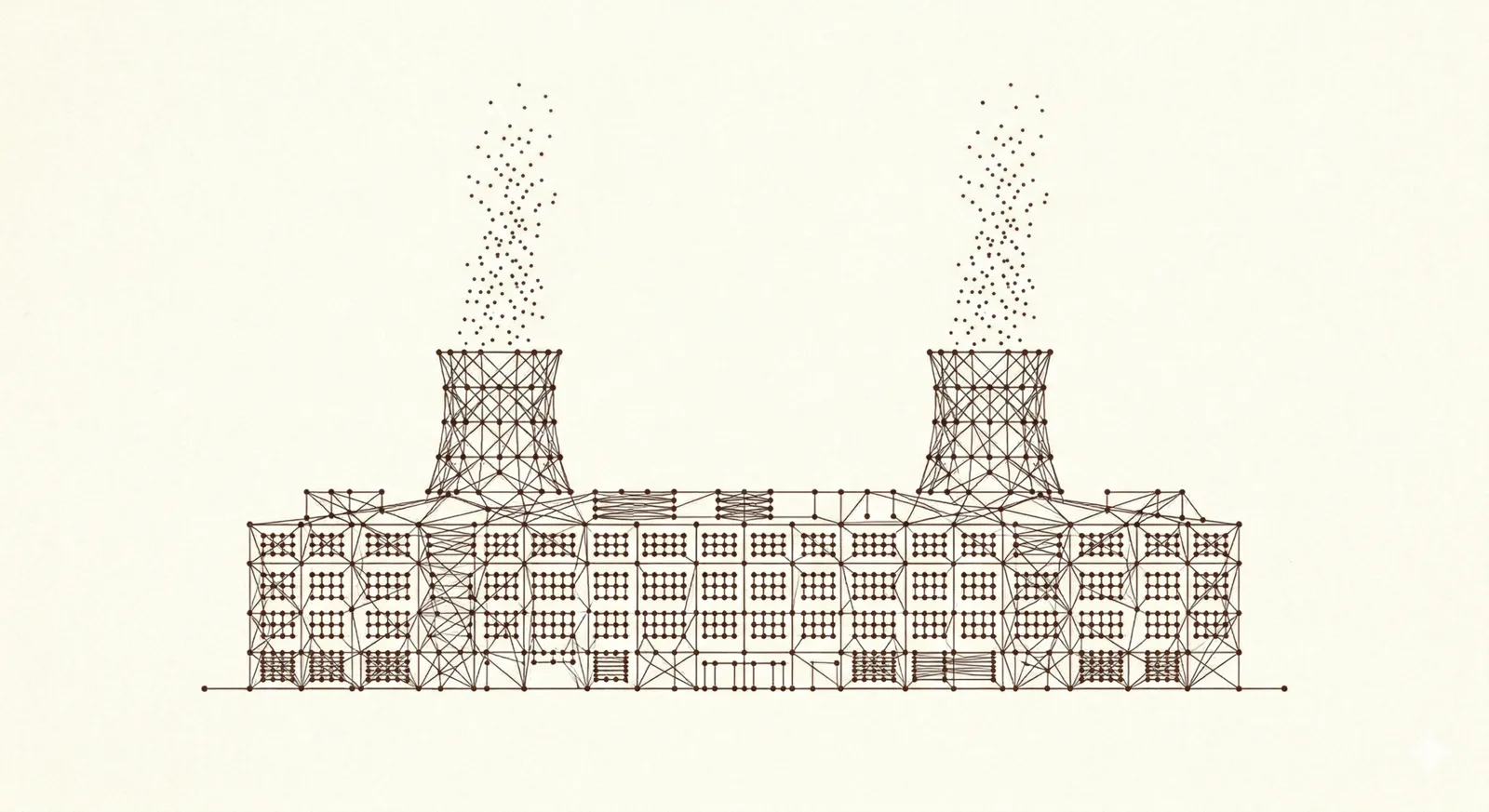
The destination is a building you have probably never seen. It’s the size of a few football fields. It’s loud inside, in a specific way, because of the cooling. Inside, a program called a load balancer looks at your request and hands it to whichever GPU is least busy in that fraction of a second, because tens of millions of people are asking something at the same time.
As that GPU works through the answer, each word it produces gets packed into a return postcard and shot back down the fibre to your screen. That is why the reply looks like it’s being typed. It isn’t. New postcards keep arriving and your browser prints them as they land.
All of that happens in a few seconds.
The thing you’d feel standing inside that building
This is the part I wanted to make concrete for myself, because the numbers on their own don’t do much for me.
Those GPUs are not the chips you find in a laptop. They are specialised compute cards that pull huge power when they are pushed, the way a Formula 1 engine pulls fuel. A single answer from a large cloud model can burn something like ten to fifteen times the electricity of a plain Google search. That sounds small until you multiply it by the hundreds of millions of prompts the big providers handle every day. Suddenly the stories about AI companies signing deals with nuclear plants and buying entire solar farms stop feeling like PR, and start feeling like arithmetic.
I build my own PCs, and there was a stretch when I’d spend evenings undervolting my CPU and GPU. The trick is to feed the chip slightly less power at the same clock speed: less heat, less fan noise, and often more sustained performance, because the chip can hold its boost longer. Modern CPUs and GPUs are not the fixed-speed parts they used to be. They have a thermal budget called TDP, and they clock up when they have power and cooling to spare, then clock back down when they don’t. The GPUs in that data centre are doing the same thing at a different scale. They run as fast as the cooling lets them. Cooling isn’t overhead. It’s how you turn a watt into useful work.
And the heat has to go somewhere. Tens of thousands of GPUs running at full tilt produce the kind of heat that will physically melt the chips if you don’t move it out of the building fast. The most efficient way to do that, today, is to evaporate clean water in cooling towers. Researchers estimate that a normal conversation of roughly ten to fifty prompts with a cloud AI can evaporate around half a litre of fresh water at the data centre. Not pumped through a closed loop. Gone into the sky.
That heat doesn’t stop at the property line. A recent study by Marinoni and colleagues used satellite thermal imaging to look at AI data centres around the world and found that the land surface temperature around them goes up by about 2°C on average once they start operating. They estimate that roughly 340 million people now live inside that warmer footprint. A heat source big enough to see from orbit.
If you stood inside that building while the model answered your question, you would hear the fans, feel the heat, and see the steam leaving the towers. Similar signals to the ones I get when I run a model on my desk, just scaled up by a factor I can’t really picture (minus the steam, of course, since steam from my desktop would mean my liquid cooler had sprung a leak).
None of this makes AI bad. I use cloud models every day and I’m going to keep using them, because for most things they are the right tool. I don’t want to end on a guilt trip, and I don’t think fear is the right frame.
I also want to be honest about who is actually responsible for the water and power question, because I think the finger gets pointed in the wrong direction a lot. The weight of this problem is not on you and me. It sits with the big providers, who choose where to build the buildings, how to cool them, and what kind of power plant to plug them into. It sits with regulators, who are, as usual, a few years behind the thing they are supposed to regulate. An individual user deciding to ask fewer questions is not going to move any of those numbers in a measurable way. Pretending otherwise is a familiar move, the same one we saw with plastic straws and household recycling: push the bill for a corporate and political problem onto the consumer, and call it personal responsibility.
What the rest of us get from understanding all this is something smaller and more useful. A clearer picture of the system we are using. When you know the building exists, the headlines change shape. “AI company buys nuclear plant” stops being a weird flex and starts looking like a power bill. “AI is thirsty” stops being a clickbait line and becomes an actual cooling tower you now understand. When a provider tells you their service lives “in the cloud”, you can hear the quotes around the word.
That, to me, is the honest takeaway for someone who just wants to use these tools well. Not a rule, not a new guilt, just a mental picture that makes the whole conversation about AI easier to read.
I still catch myself sometimes, picturing the building before I press Enter on something a plain search would have answered in half a second. Not because I think I am saving the planet. Just because I like knowing what I’m actually doing.