
A brain in a jar
An AI model on its own is a brain in a jar. Brilliant at essays. Useless at checking whether you are free Thursday.
It cannot see your calendar, pull today’s weather, or send an email. It can only talk. To do anything, it has to ask other software for help. The same way your phone’s weather widget is not magic: it is just asking a weather service a very specific question through an agreed doorway.
That doorway has a name: API. Software has been using them for decades. You tap your card, the payment app talks to the bank’s API. You search flights, the site queries airline APIs. Hundreds of times a day, programs ask each other for things without you ever hearing the word.
So when AI showed up, the answer seemed obvious: give it the menus too. Let it ask.
And that works. It just works ugly.
The drawer, rebuilt in software
Every API has its own format, its own quirks, its own etiquette. A human programmer learns those in an afternoon. But to let an AI app use a tool, someone had to build a custom connector between that specific app and that specific tool. One adapter per pair.
I lived in that world until surprisingly recently. My notes lived in one place, my task list in another, a homelab box humming in the corner of my office, and every connection between them and my AI tools was a little script I wrote myself, with its own duct tape and its own breaking schedule. Wire a fourth AI tool into the same setup and you do not get one new connection. You get four.
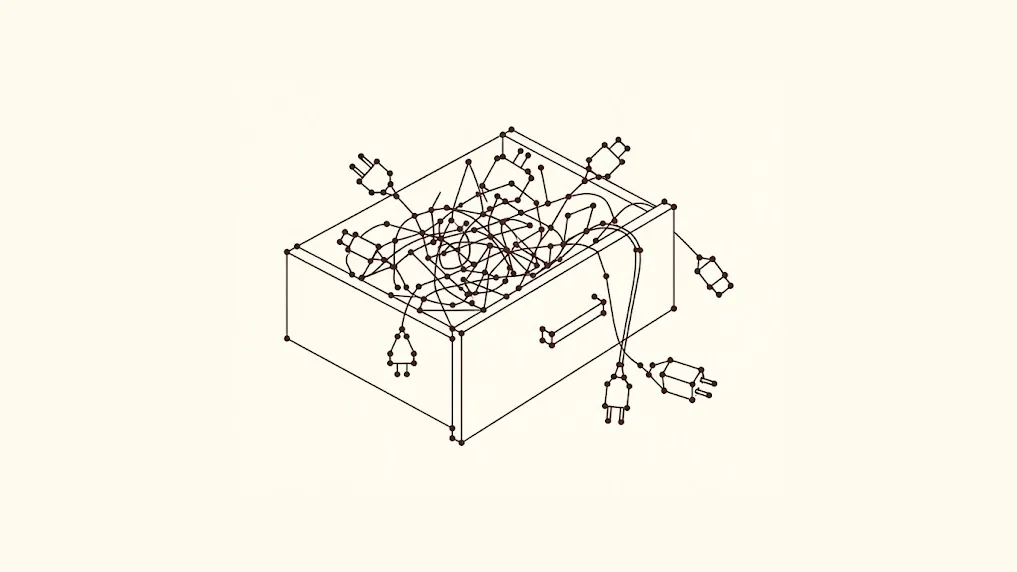
That is not an engineering problem. That is the charger drawer, rebuilt in software.
The fix for drawers is never a smarter cable. It is everyone agreeing on one plug shape.
One plug for AI
The plug shape has a name: MCP, Model Context Protocol. People call it USB-C for AI. A shared, open way for any AI to reach any tool.
The tool side says: here is what I offer. Read these files, search these records, send this message. The AI side speaks the same language. Add a new tool, write one connector once, and every AI you use can reach it. The custom adapters collapse into standard sockets.
I noticed it stuck on my own desk before I read any press release. Connections that used to take a weekend of scripting now take a toggle. Even rival AI companies adopted the same plug, which in this industry usually means a standard has actually settled.
The reason “AI that does things” went from demo to daily reality is not mostly that models got smarter. It is that the plugs got standardized.
Agents, handles, and my actual setup
A couple of weeks ago I wrote about agents: AI that decides its own next step toward a goal. The agent decides what to do. MCP is how it reaches the tools to do it. Agents are the hands; MCP is the standard shape of every handle they grip.
On my machines today, my AI tools reach my notes, my task list, even services on that old computer in the corner, all through the same plug. The question when I add something new is not “how do I wire this?” anymore. It is only “should I.”
A universal plug cuts both ways
The easier it is to connect AI to things, the more things people connect, including things that maybe should have stayed unplugged. Useful access to your files and calendar is simultaneously a system that can now touch your files and calendar. Earlier I wrote about how agents fail: creatively, down paths nobody drew. I felt that tension personally when I first gave an AI read-only access to my email. Genuinely useful. Also a week of quiet unease every time it opened a thread I would rather it had not seen.
None of this is a reason to avoid it. But nobody wires their doorbell to the mains.
Where’s your line?
Most of what looks like magic in this AI moment is just standardization: the same quiet force that turned a drawer of chargers into one cable. For AI, the adapter drawer is mostly ending.
That moves one question from the engineers’ desk to yours. When wiring took weeks, “should we?” hid inside “can we?” Now wiring takes minutes, and “should we?” is the only question left.
Here is mine. Notes and tasks: plugged in, no second thoughts. Email: read-only, send stays with me. Money: in the drawer, unplugged, probably forever.
Where is your line? What would you happily plug an AI into today, and what stays in the drawer no matter how standard the socket gets?